
Introduction
In the spring of 2026, environmental activist Erin Brockovich launched a website allowing people to report proposed or active data center builds in their communities. Within 72 hours, the site crashed twice due to the sheer amount of traffic. Within weeks over 8,000 reports had been collected from 47 states within the U.S. Data gathered by entities like the International Energy Agency (IEA) show that the environmental impact and strain on existing energy grids created by data center hyperscaling are not just hyperbole, and public opposition to their expansion is significant and growing.
AI’s capabilities are undeniable: it injects previously unreachable levels of efficiency into systems that impact important initiatives like medical research or smart energy grid development. According to a 2025 IEA report, in the Green Energy sector alone, AI is responsible for reducing renewable energy outages by up to 40%. Google’s DeepMind has shown to increase solar energy efficiency by 20% through AI-optimized panel orientation and sunlight tracking.
AI technology presents incredible opportunities to advance society, but without thoughtful decision making and until more guardrails are in place, accessing those benefits comes at a steep price. So the pressing question is: is it possible to access the benefits of AI without bearing the social and environmental costs imposed by hyperscaling data centers?
Yes, and this article describes how.
Do We Really Need This Many Data Centers?
There are currently 4,542 data centers operating in the U.S. There are more data centers in the U.S. than any other country on earth.
As of July 2026, the United States has more data centers than any other country on earth. There are currently 4,542 operating, another 809 under construction, and 3,962 more announced for future builds. A loose regulatory environment along with a government-sanctioned push to build out AI infrastructure at record pace can be cited as principal drivers behind this momentum. However, even the people financing the data center boom are not entirely convinced that hyperscaling is the best path forward.
Microsoft CEO Satya Nadella publicly stated earlier this year that “there will be an overbuild” and S&P Global has confirmed mounting fears that demand may not materialize to meet the amount of infrastructure being built. Further, between 30% and 50% of planned US data centers for 2026 are projected to be delayed or canceled as public outcry increases and necessary funding fails to materialize.
China’s DeepSeek artificial intelligence lab presents yet another challenge to the assumption that massive and expensive compute is required for competitive AI systems. According to independent benchmark tests, the lab’s V4 models deliver near-frontier performance, trailing leading US models by only 3 to 6 months, while costing between 30 and 50 times less to run per API call.
What’s eye-opening about this development is the Chinese LLMs have been trained at a fraction of the cost of US-based LLMs and operate using less compute power. Chinese models depend on a Mixture-of-Experts (MoE) approach to processing that’s far more conservative, activating resources only as needed. Most US models, in comparison, use brute-force scaling that relies on massive multi-million dollar chip clusters and “all-models-active” parameters for every token processed.
The True Cost of Hyperscale
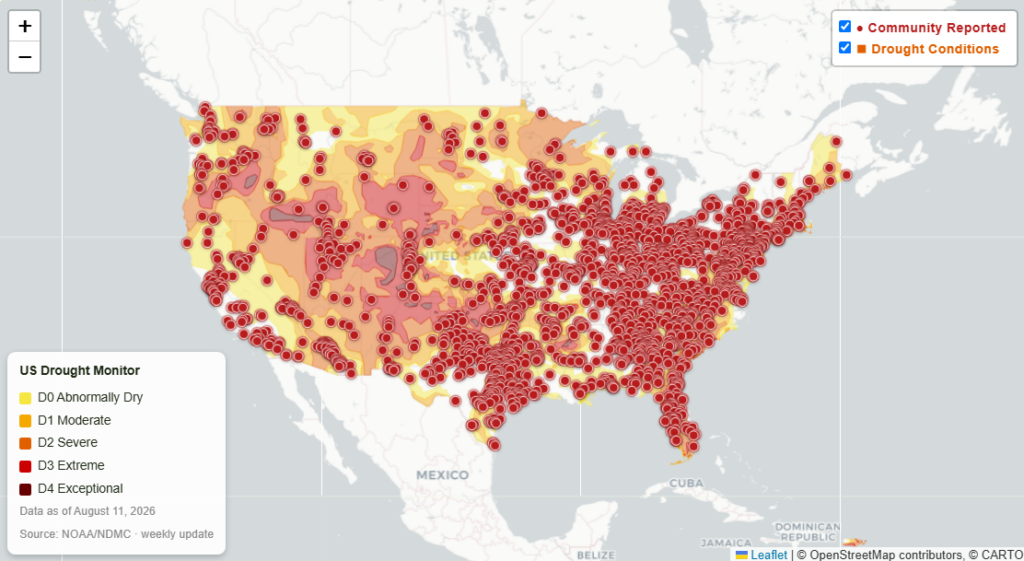
LLMs are expensive to run, not just in operational costs, but in tertiary costs measured in land use and environmental impact. This reality is quickly becoming recognized by the general public as demonstrated by a recent Gallup poll that showed overwhelming disapproval for data centers being placed in communities.
- Energy – Data centers presently consume 176 terawatt hours of electricity annually in the US alone. Globally, the IEA reports that data centers used 415 TWh in 2024 and projects that consumption will reach 945 TWh by 2030, with AI being the primary driver. A single large data center can require between 100 and 1,000 megawatts of electricity, the equivalent of powering up to 800,000 average homes.
- Water – US data centers currently use between 17 and 19 billion gallons of water annually for cooling. The Water Foundation projects that figure will reach between 60 and 110 billion gallons per year by 2030 as AI server density increases. Poorly planned data centers placed without regard to local water availability can pose a real threat to drought-stressed communities.
- Land – An average full-scale data center occupies 100,000 square feet, while hyperscale facilities can sprawl across 10 million square feet or more. In Bessemer, Alabama, a proposed four-million-square-foot facility known as Project Marvel would permanently clear at least 100 acres of wooded land from a 700-acre forested site while also threatening the Birmingham darter, a newly discovered rare fish species.
Paradoxically, AI usage is on the rise with an estimated 1 billion people employing AI tools daily according to UNESCO. Even as people oppose the infrastructure that supports its capabilities, more industries are exploring its adoption. Similar to how the Internet became a ubiquitous technology required for economic growth and competitiveness, AI is on a track to become a necessary component of how most businesses operate.
So how can a business responsibly incorporate AI while minimizing its impact on the environment, existing energy grids, and the community in which it’s situated? One high-impact decision is implementing an AI system that depends on, or actively prioritizes, SLMs over LLMs.
Large Language Models (LLM) Versus Small Language Models (SLM)
Most of the major AI tools that have quickly become recognizable brands (Claude, ChatGPT, Gemini, etc.) are powered by general purpose Large Language Models or LLMs. These types of agents contain between 70 billion and 175 billion parameters, parameters being the mathematical weights that determine how a model processes and generates language. The goal of an LLM is to be able to handle virtually any query fed into it while also being capable of writing and conversing like a human. This is an impressive feat for a model to accomplish and also extraordinarily expensive to sustain at scale.
As an example, a single ChatGPT query consumes approximately 25 times more energy than a traditional Google search, according to the IEA. Every query sent to a cloud-based LLM routes through a hyperscale data center, consuming energy and water in amounts that aren’t modified to precisely match the actual computational power required by a task. According to a UNESCO and University College London report published in July 2025, generative AI’s annual energy footprint is already equivalent to that of a low-income country and is growing exponentially.
Conversely, Small Language Models or SLMs follow a decidedly different approach. Rather than depending on one massive generalist system, they function as small-footprint, locally housed, precision tools. Being task-specific, a typical SLM only contains between 1 billion and 10 billion parameters. They are trained to do defined jobs well at depth, not everything adequately.
A peer-reviewed study published in the Proceedings of the 6th International Conference on AI Research found that SLMs consumed 60% to 70% less energy and water than their LLM counterparts across comparable queries, while matching LLM accuracy on domain-specific tasks, including mathematics and reading comprehension. Research by UNESCO goes further, finding that small, targeted models can reduce energy consumption by up to 90% compared to large generalist systems without compromising performance. This demonstrates a significant win for responsible AI development and deployment.
Yet another approach to SLM implementation is a “mixture-of-experts” architecture that assembles several specialized SLMs into a system, and only actually activating each model as needed. For example, one SLM can be dedicated to handling common customer service queries while another within the same organization can be dedicated to managing translating content into different languages.
The Cost and Security Benefits of SLMs
A 7-billion parameter SLM costs between 10 to 30 times less to operate than an LLM.
We’ve discussed the incredible expense of running LLMs. In comparison, a 7-billion parameter SLM costs between 10 to 30 times less to serve per API call than a general purpose LLM. Case in point, Microsoft’s Phi-3.5-Mini SLM matches ChatGPT-3.5’s performance on targeted tasks while requiring a fraction of the latter’s computational power. Analysis of multiple enterprise-level deployments of LLMs between 2025 and 2026 surfaced a consistent finding: between 70% to 90% of routine corporate AI workloads could be handled more accurately, and at significantly lower latency, by precision-tuned SLM systems.
The flexibility and lower resource requirements of SLMs also mean they can be deployed on-premises. In this type of setup, local servers and high-end workstations can be employed to host SLM operations, thereby completely avoiding dependence on cloud-based data centers while also improving data retrieval and processing times. Clean renewable energy can be added into the loop to further reduce environmental impact and capture lower operating costs.
Lastly, operating local SLMs allows organizations access to improved digital security, something that is particularly crucial for highly regulated industries or sectors commonly targeted by cyber criminals. With the AI system completely contained within the organization, there is greater control over who has access to sensitive information, how data is managed, and how it’s stored and protected.
When to Opt For LLM AI Over SLM
For organizations committed to adopting a Lean, Clean & Local approach to AI deployment, SLMs represent a superior choice. However, in some particular scenarios LLM can be a better choice. Where the need exists to use both LLM and SLM-based AI, it’s appropriate to use a tiered approach that assigns SLMs to high-volume, domain-specific, mission-critical, daily work while reserving LLMs for less frequent more exogenous tasks.
Best-fit examples for LLMs include work that calls for complex multi-domain reasoning, synthesis across large and diverse unstructured datasets, and genuinely open-ended creative or strategic work requiring the full capability of a large generalist model:
- Navigating complex global environmental regulations
- Synthesizing comprehensive annual ESG reports
- Auditing global multi-tier supply chains
- Brainstorming breakthrough sustainable product designs
- Forecasting macroeconomic renewable trends
- Drafting global stakeholder sustainability communications
To stay compliant with sustainability commitments or an organization’s Mission-Aligned AI Standard, selected LLM vendors should also align with best environmental and transparency practices. That means using providers who have adopted clean energy to supplant fossil fuel dependency, water preservation protocols, and issue regular reporting on environmental measures taken.
Open Source SLMs to Explore For Lean, Clean & Local AI Deployment
All of the following models can be downloaded and run locally in completely air-gapped (offline with no internet connection) environments. Because they are open-source or open-weight models, their underlying weight files and architectures can be downloaded once and run entirely locally using offline inference engines (such as Ollama, vLLM, Llama.cpp, or LM Studio).
- Phi-4-mini (3.8B): Microsoft’s reasoning-focused model punches well above its weight class, offering exceptional math, logic, and coding capabilities with minimal resource consumption.
- Gemma (Gemma 2 2B/9B & Gemma 4 E-Series): Google’s lightweight open-weight models are fine-tuned for strong multilingual and multi-turn conversational tasks on consumer hardware.
- Ministral (Ministral 3B / 8B): Mistral AI’s edge-oriented models are engineered for low-latency performance, robust function calling, and localized processing.
- SmolLM (SmolLM2 / SmolLM3): Built by Hugging Face, these ultra-compact models (ranging from 135M to 3B parameters) are purpose-built for efficient on-device execution and fast instruction-following.
- Llama 3.2 (3B / 1B): Developed by Meta, these highly popular compact models are optimized for edge devices, local deployment, and text-generation tasks while maintaining a tiny hardware footprint.
References
- Erin Brockovich Data Center Reporting Map
https://www.brockovichdatacenter.com/ - International Energy Agency — Key Questions on Energy and AI
https://www.iea.org/reports/key-questions-on-energy-and-ai/executive-summary - UNESCO — Small Changes in AI Models Can Reduce Energy Use by 90%
https://www.unesco.org/en/articles/ai-large-language-models-new-report-shows-small-changes-can-reduce-energy-use-90 - Gallup — Americans Oppose Data Centers in Their Area (March 2026) https://news.gallup.com/poll/709772/americans-oppose-data-centers-area.aspx
- Inside Climate News — Bessemer, Alabama Data Center to Ask for Additional 900 Acres https://insideclimatenews.org/news/14012026/bessemer-alabama-data-center-to-ask-for-additional-900-acres/
- DataCamp — DeepSeek V4 Review: 30-50x Lower API Cost vs US Models https://www.datacamp.com/blog/deepseek-v4
- CIGI — DeepSeek and China’s AI Innovation in US-China Tech Competition https://www.cigionline.org/articles/deepseek-and-chinas-ai-innovation-in-us-china-tech-competition/
- TechJack Solutions — DeepSeek V4 vs Frontier Models Benchmark (August 2026) https://techjacksolutions.com/ai-tools/deepseek/deepseek-v4-vs-frontier-models/
- ICAIR 2025 — SLMs Consume 60-70% Less Energy and Water Than LLMs
https://papers.academic-conferences.org/index.php/icair/article/view/4345 - Microsoft — Phi-3.5-Mini SLM: Multilingual High-Quality Performance https://techcommunity.microsoft.com/blog/azure-ai-foundry-blog/discover-the-new-multi-lingual-high-quality-phi-3-5-slms/4225280
- HackerNoon — Small Language Models Have a Trillion-Dollar Future: 70-90% of Enterprise Workloads Fit SLM Architecture (May 2026)
https://hackernoon.com/small-language-models-have-a-trillion-dollar-future - Funnel Amp — AI & Ethics: Mission-Aligned AI Standard
https://funnelamp.com/ai-ethics-deploying-a-bad-ai-agent-in-a-sustainable-sector-is-a-reputational-hazard/